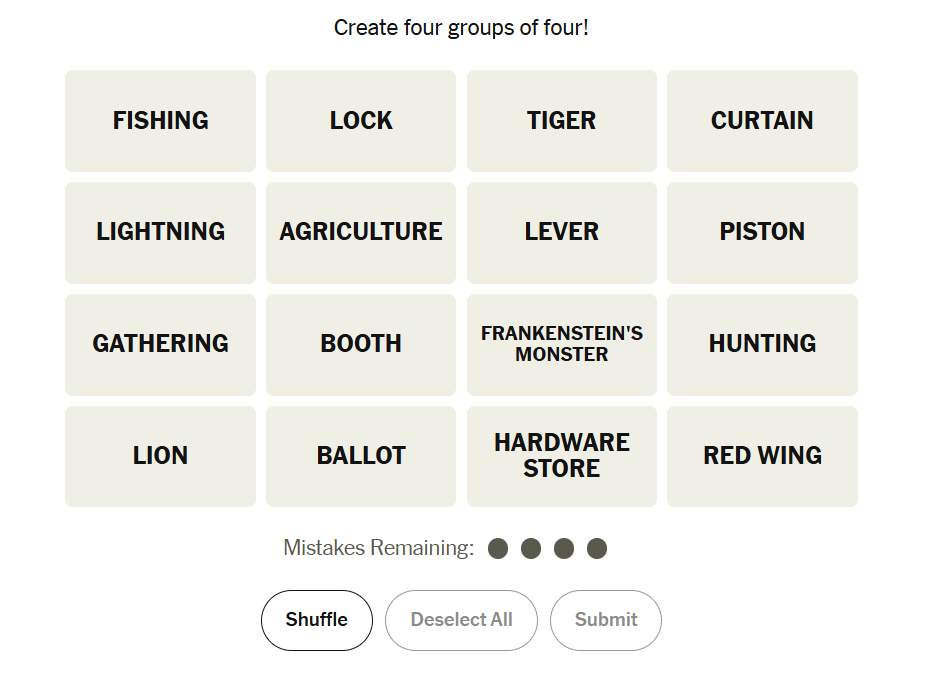
The New York Times Connections puzzle challenges players to sort 16 seemingly unrelated words into four connected groups. Each group shares a hidden link. Today’s grid features physical actions, clever rearrangements, and nostalgic references, rendering it both playful and somewhat deceptive. Below, you will find gentle hints to aid your thinking, followed by the complete solutions once you’re ready to verify your answers.
NYT Connections Puzzle Overview: 26 March 2026
Today’s puzzle struck a good balance, combining straightforward categories with one that required a degree of lateral thinking. Some groups were quick to identify, whilst others depended on recognising broader concepts rather than direct similarities. It was the type of grid that rewarded patience and a second look at seemingly unrelated words.

NYT Connections Hints: 26 March 2026
Category 1:
- Consider how humans procure food from nature.
- These methods date back to early civilisations.
- Some are still widely practised today.
- All involve sourcing food directly.
Category 2:
- These items are linked to a specific city in the U.S.A.
- You may recognise them from sports teams.
- Each word represents a team name.
- All belong to the same region.
Category 3:
- Imagine stepping into a private voting booth.
- These are items you would interact with there.
- Associated with elections and privacy.
- Physical components of the setup.
Category 4:
- Each item is connected by a common word.
- That shared word relates to fastening or striking.
- Some meanings are literal, others are figurative.
- Consider what they might “have”.
NYT Connections Answers: 26 March 2026
Here are the answers, grouped by category.
Category 1:

Category 2:
Category 3:
Category 4:
Conclusion & Quick Strategy Tip
The 26 March 2026 Connections puzzle combines straightforward action words with trickier conceptual links, making it particularly satisfying once everything falls into place. A quick strategy tip: lock in the obvious verb groups early, then examine the remaining words for structural patterns or shared cultural references.