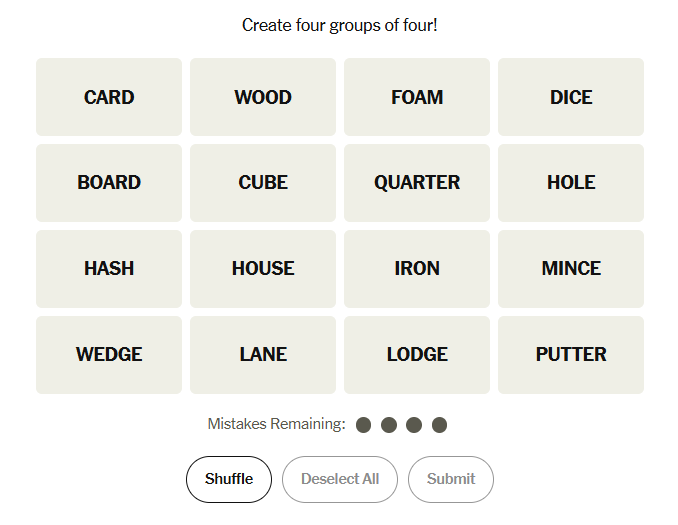
The New York Times Connections puzzle presents a fun challenge where players must categorize 16 seemingly random words into four interconnected groups, each sharing a hidden theme. Today’s grid features a mix of physical actions, clever rearrangements, and nostalgic twists, adding an element of playfulness alongside some deceptive clues. Here, you’ll find helpful hints to spark your thought process, followed by the complete answers whenever you’re ready to review your work.
Overview of the NYT Connections Puzzle: 3 February 2026
This edition of the Connections puzzle emphasizes actions and lateral thinking. Some of the groupings may seem obvious, while others require digging deeper to uncover underlying patterns. The anagram section is particularly enticing right from the start, while the last category will reward those who remember beloved childhood games.

Hints for NYT Connections: 3 February 2026
Category 1:
- Words that indicate the act of breaking something down into smaller pieces
- Commonly found in culinary contexts
- Each word suggests a deliberate breakdown
- Often used as action verbs
Category 2:
- Focus on hospitality rather than property ownership
- Words associated with temporary lodging
- Commonly linked to travel and accommodation
- Each can act as a verb
Category 3:
- A category related to sports equipment
- All items are typically swung or handled in a similar manner
- Found within the same type of sporting venue
- The materials used are significant here
Category 4:
- All terms pair seamlessly with the same initial word
- Consider cognitive processes rather than just physical objects
- Each forms a common compound phrase
- The leading word precedes each item
Answers for NYT Connections: 3 February 2026
Below are the answers, organized by category.
Category 1:

Category 2:
Category 3:
Category 4:
Conclusion & Quick Strategy Tip
The Connections puzzle for 3 February 2026 provides a balanced mix of straightforward action words and trickier conceptual connections, which makes it gratifying once the solution falls into place. Quick tip: secure the obvious verb groups early on, then sift through the remaining words for structural patterns or shared cultural references.